


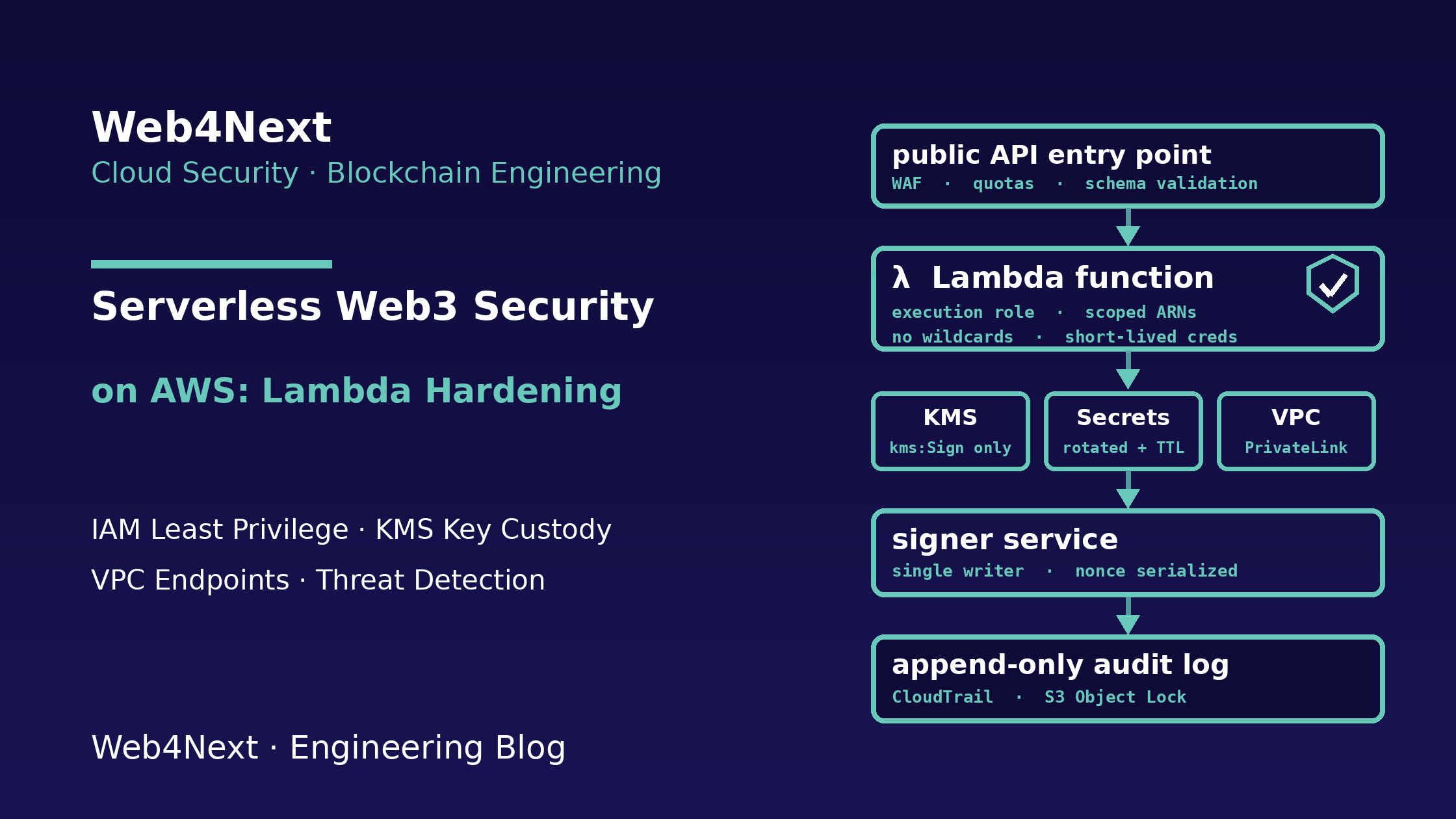
Serverless Web3 Security on AWS: Lambda Hardening Guide
Serverless Web3 security on AWS is not a smaller version of ordinary cloud security — it is a different problem. Functions appear on demand, hold no state, and usually sit between a public API and an irreversible ledger, so one over-permissive execution role or one leaked signing key can move real value in milliseconds. This guide covers the architecture, identity, key custody, network, supply-chain and detection controls that let teams run blockchain workloads on AWS Lambda without dragging the anti-patterns of long-running servers along with them.
Why Serverless Web3 Security on AWS Needs Its Own Playbook
Under the shared responsibility model, AWS secures the Lambda service itself: the control plane, the managed runtimes and the hosts your code runs on. You still own the function code, its dependencies, its IAM role, its data, its keys and its configuration. Serverless removes patching toil — it does not remove accountability.
Statelessness cuts both ways. There is no shell to pivot into and no persistent disk to loot, which is a genuine improvement. But every invocation re-establishes trust: credentials are fetched, network paths are chosen and identity is assumed again and again. Those per-invocation decisions become your main attack surface.
The blast radius is asymmetric. A classic REST backend leaking a user list is a serious incident. A blockchain backend leaking a key that can sign transfers is a terminal one, because the ledger has no rollback. Design for the second case even when you are building the first.
Finally, cost is a security property in serverless. Because you pay per invocation, an attacker who can trigger your function also controls your bill — the “denial of wallet” pattern. Rate limits, quotas and concurrency caps are security controls, not just FinOps hygiene.
Threat Model for Lambda-Backed Blockchain Workloads
Start by listing the assets your functions can reach: RPC provider keys, KMS key identifiers, database credentials, webhook HMAC secrets, custody or HSM credentials, and the nonce state that keeps transactions unique. Then map trust boundaries: the API layer, the function, the VPC resources behind it, the external RPC or indexer, and the chain itself.
Four attack paths that show up again and again
- Credential exposure. Secrets sitting in environment variables, echoed into logs, or committed into a layer. Anything with
lambda:GetFunctionConfigurationcan read environment variables, and structured logs leak more than teams expect. - Over-permissive execution roles. Wildcard actions on wildcard resources turn a single vulnerable dependency into a full account pivot, because the dependency inherits every permission the role holds.
- Weak invoke paths. Unauthenticated function URLs, webhook handlers that never verify a signature, and signed requests that can be replayed. A forged “deposit confirmed” callback that reaches a minting function is a direct loss.
- Nonce and idempotency collisions. Concurrent invocations racing for the same wallet nonce produce duplicate or stuck transactions, and retries without idempotency keys produce double payouts.
Add the supply-chain variant: typosquatted packages, dependency confusion in a private registry, and layers built from unpinned sources. In Web3 codebases that import large SDKs, a single malicious transitive dependency runs with your signer’s role.
Identity and Least-Privilege Design for Lambda Execution Roles
Give each function its own role and scope it to the exact resources it touches. Wildcards in a policy are a design smell that deserves the same scrutiny as a hard-coded key. Where a function only writes to one DynamoDB table, name that table’s ARN; where it only reads one secret, name that secret.
Eliminate long-lived credentials. Deployment pipelines should assume a role through OIDC federation from your CI provider, receiving short-lived temporary credentials instead of stored access keys. Use separate AWS accounts for development, staging and production, and apply service control policies so a compromised development role cannot reach production key material.
Use condition keys to narrow trust further: aws:SourceArn and aws:SourceAccount on resource policies, aws:PrincipalArn on role trust policies, and explicit principals for cross-account invocation. Permissions boundaries are useful when platform teams let product teams manage their own roles without letting them escalate.
Then split duties inside the workload. The function that receives a public request should not be the function that can sign. Put a queue or an internal API between the untrusted entry point and the signer, so the signer’s role is reachable only by a narrow, authenticated caller. Validate all policies in CI with IAM Access Analyzer policy validation plus an IaC scanner such as Checkov or cfn-guard.
Key Custody: Where Signing Keys Must and Must Not Live
This is the part of serverless Web3 security on AWS that most teams get wrong first. Never store a private key in a Lambda environment variable. Environment variables are encrypted at rest, but they are decrypted for the runtime and readable in memory by anything executing in that function — including a compromised dependency. They are also visible to anyone with configuration read access and often end up in error output.
Prefer AWS KMS asymmetric keys so the private key never leaves the HSM-backed boundary. KMS supports ECC_SECG_P256K1 keys for secp256k1 curves, which covers common Ethereum-style signing flows, and the Sign API lets you produce signatures without exporting material. Grant kms:Sign as narrowly as possible with grant constraints, and alarm on signing volume: a sudden spike is one of the highest-signal detections you can have.
Two practical caveats. KMS returns DER-encoded signatures, so if your client library expects raw r||s encoding you must convert explicitly and test against a testnet before trusting the path. And some recovery-identifier flows are not supported natively, so verify library compatibility rather than assuming a drop-in replacement.
For treasury wallets or any key above a value threshold, single-key KMS is not enough. Use AWS CloudHSM or an external MPC or HSM custody provider, and enforce quorum approval off-chain before the sign call is ever made. Store API keys and RPC URLs in Secrets Manager or Parameter Store with automatic rotation, cache them with a short TTL, and never log the value. Envelope-encrypt stored user data with a customer-managed key, and keep personal data off-chain, referenced only by hash.
Network, Data and Runtime Controls for Serverless Web3 Stacks
Attach functions that touch internal data to a VPC, and reach AWS services through VPC endpoints rather than the public internet. PrivateLink endpoints for Secrets Manager, KMS, S3, DynamoDB and SQS keep traffic off the public network and let you remove NAT gateways, which shrinks both the egress path and the bill. VPC-attached Lambda uses AWS-managed Hyperplane network interfaces, so there are no ENIs for you to patch.
Prefer private RPC endpoints over public URLs with embedded keys. If you must use a shared provider, keep the key in Secrets Manager, pin the egress path, and monitor request volume for abuse. Public entry points deserve layered controls: API Gateway with AWS WAF managed rules plus rate-based rules, request validation, usage plans with per-key quotas, and low timeouts. If you use function URLs, require IAM authentication or verify a signed request — never leave an unauthenticated URL that can reach a signer.
Treat every inbound callback as untrusted. Verify HMAC signatures with a timestamp window and a replay cache, validate the payload against a strict JSON schema, and only then act. On the data side, enable encryption with customer-managed keys, enforce TLS with aws:SecureTransport bucket policies, keep buckets private, and issue short-lived presigned URLs when you must share objects.
Two serverless-specific runtime controls matter more than most teams expect. First, set reserved concurrency on signer functions so a traffic spike cannot fan out into thousands of concurrent sign calls, and keep timeouts short. Second, solve idempotency and ordering deliberately: use conditional writes keyed on a request identifier, store the resulting transaction hash against the intent, and serialize nonce-bearing operations through an SQS FIFO queue with one message group per wallet. Relying on Lambda concurrency for nonce management is how duplicate transactions happen.
Supply Chain and Deployment Hardening with DevSecOps on AWS
Supply chain is the least visible part of serverless Web3 security on AWS, and often the fastest to exploit. Pin dependencies with a lockfile and mirror them to a private registry such as CodeArtifact to defeat dependency confusion. Do not install packages at runtime, and treat layers as build artifacts that require review. Turn on AWS Lambda code signing so only signed artifacts can be deployed, and for container-image functions use minimal base images with ECR image scanning and Inspector coverage.
Make infrastructure as code the only path to change. Apply Terraform or CDK through CI with plan review, keep deployment roles least-privileged, require approval for production, and run drift detection so a console edit cannot silently widen a security group. Generate an SBOM for every release so a new CVE can be matched against what you actually ship.
Watch the Web3-specific edge cases. A server-side request forgery bug in a function that holds a signer role is effectively a signing oracle, so validate and allowlist every outbound URL. Prototype pollution in a JSON-heavy parser can reshape the object your signing logic reads. And redact aggressively in logs: request bodies in this domain routinely contain signatures, addresses and session material.
Choosing the Right Compute for Each Web3 Component
Serverless is excellent for bursty, stateless request handling and poor for anything that needs a single writer or a long-lived connection. Most mature Web3 platforms end up hybrid, and that is fine — just be explicit about which component gets which runtime.
| Workload | AWS Lambda | AWS Fargate | Amazon EKS |
|---|---|---|---|
| Sporadic API and webhook handlers | Best fit: scale to zero, per-request identity, cheap isolation | Works, but you pay for idle capacity | Operationally heavy for this alone |
| Transaction signing and nonce management | Acceptable only with KMS or HSM signing and serialized writes | Strong fit: one long-lived writer per wallet | Strong fit if you already run a cluster |
| Indexers and WebSocket subscriptions | Unsuitable: 15-minute execution ceiling, no persistent connection | Good fit for steady streams | Good fit, more control, more overhead |
| Blockchain node or private RPC | Not viable: storage and connection needs | Possible with careful storage sizing | Typical choice with EC2 or bare metal |
| Batch reconciliation and reporting | Excellent: event-driven, ephemeral, parallel | Fine for long jobs | Fine, but usually unnecessary |
The rule of thumb: use Lambda for breadth — many small, independent, stateless tasks — and use a container runtime for depth, meaning anything that owns in-memory state, a socket, or a nonce sequence.
Detection, Observability and Incident Response
Good serverless Web3 security on AWS depends on telemetry you can act on within minutes. Enable CloudTrail management events everywhere plus data events on the buckets and tables that hold state, turn on GuardDuty with Lambda protection, and use AWS Config rules to catch drift such as a widened role or a public bucket.
Alarm on the signals that precede a loss: error-rate spikes, throttles, unexpected concurrency, kms:Sign volume, IAM policy changes, and unusual outbound destinations in VPC flow logs. Trace requests end to end with X-Ray and structured JSON logs carrying a correlation identifier, the intent identifier and the resulting transaction hash. Write signing events to an immutable audit log using S3 Object Lock, because that record is what you will need during a dispute or an audit.
Rehearse the response. Rotate the exposed key or secret first, then disable the invoke path, then snapshot logs, then check for on-chain side effects and reconcile state. Keep a pre-approved pause switch — a feature flag in Parameter Store that the signer checks before every call — because you cannot undo a transaction, only stop the next one. Game-day a leaked RPC key and a duplicated-nonce incident before either happens for real.
Frequently Asked Questions
Can I store blockchain private keys in Lambda environment variables? No. They are decrypted for the runtime, readable by any code in the function, visible to principals with configuration read access, and easy to leak into logs. Use KMS asymmetric keys, CloudHSM or an external MPC provider instead.
Is putting Lambda in a VPC enough to secure a Web3 backend? No. A VPC gives you network isolation only. You still need scoped IAM roles, managed secrets, signature verification on inbound callbacks, WAF and rate limiting on public entry points, and detection that covers the control plane as well as the data plane.
Does serverless remove the need for patching? Partly. AWS patches the managed runtime and the underlying hosts, but you still own your dependencies, layers, container images and configuration. Deprecated runtimes stop receiving updates, so runtime upgrades remain your responsibility.
How do I prevent duplicate on-chain transactions from retried invocations? Use an idempotency key with a conditional write, store the resulting transaction hash against the original intent, and route nonce-bearing work through an SQS FIFO queue with one message group per wallet so only one writer acts at a time.
Nothing here is legal or compliance advice. Regulatory treatment of digital assets varies by jurisdiction and changes frequently, so validate your architecture against current AWS documentation and your own counsel before relying on any single control.
Rizwan Mansoori